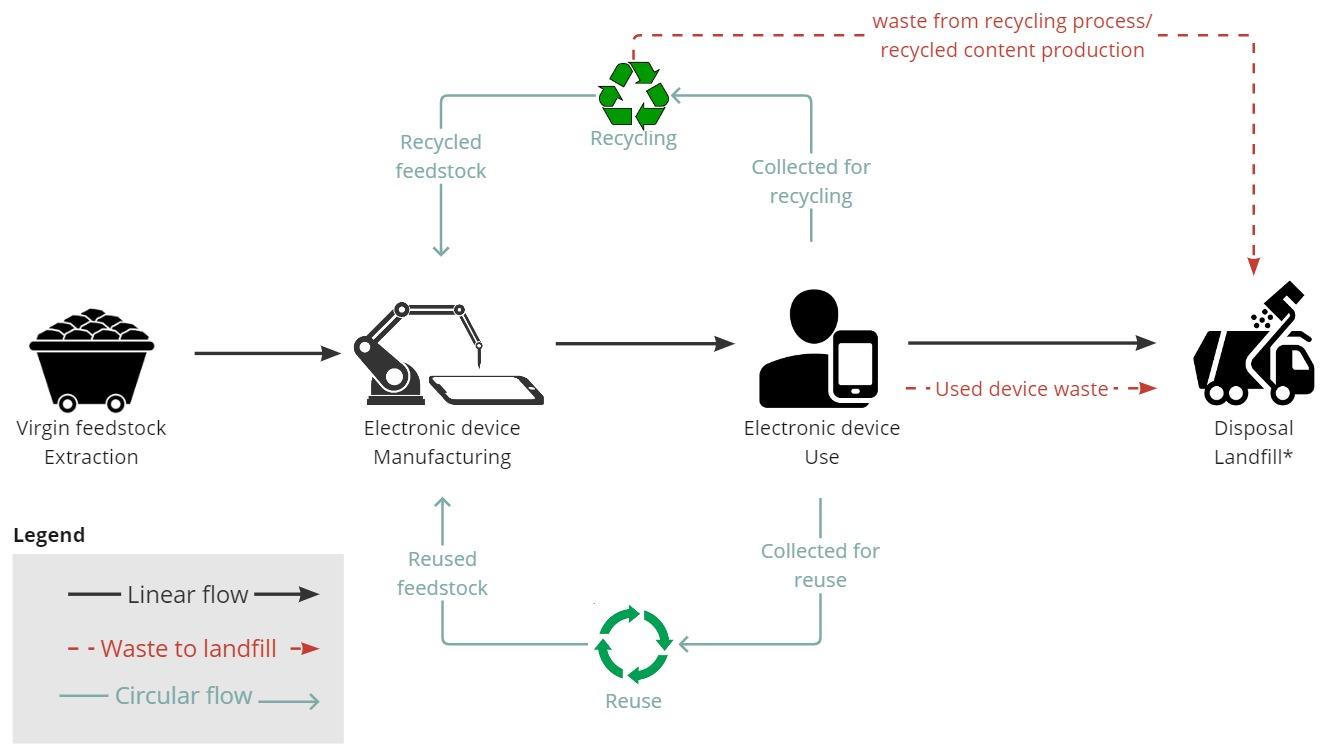
Figure 3 Summarized representation of the MCI material flows. Only landfill is considered in the MCI for electronic devices. Energy recovery as part of a circular strategy only applies to biological materials following the MCI's conditions.
Figure 3 Summarized representation of the MCI material flows. Only landfill is considered in the MCI for electronic devices. Energy recovery as part of a circular strategy only applies to biological materials following the MCI's conditions.
| Symbol | Definition by the MCI | Guidelines for the project scenario | Guidelines for the baseline scenario |
| M | Mass of a product | Total mass (kg) of refurbished devices in the project scenario, according to Table 3. M = \sum ( N_{rec\ and \ ref\ devices.i} \ *\ W_{device.i} Where N_{rec\ and \ ref\ devices.i} is the number of refurbished devices i, and W_{device.i}represents the weight in kilograms of device i | Consider the same guidelines as for the project scenario |
| Fr | Fraction of mass of a product's feedstock from recycled sources | Assumed zero | Assumed zero |
| Fu | Fraction of mass of a product's feedstock from reused sources | Considers the mass of devices refurbished (M) and the mass of new pieces acquired (N_p, in kg): Fu = (M-N_p)/M Project developers shall provide N_p or an assumption based on its activity. If not available, 9% of virgin pieces will be considered in full refurbishing devices. | Assumed zero |
| Fs | Fraction of a product's biological feedstock from Sustained production. | It is assumed that no biological feedstock is used in electronic devices. | Consider the same guidelines as for the project scenario |
| V | Material that is not from reuse, recycling or biological material from sustained production. | The amount of virgin materials used in the project scenario is the same as the Np when virgin material shall be extracted to produce new pieces. | All the input materials are considered virgin as no reuse or recycled materials are assumed in a status quo scenario. |
| Cr | Fraction of mass of a product being collected to go into a recycling process | Value based on the collection rate of each country and its recycling rate as presented in the GHG quantification. After the end of the device's first and second life, the product is assumed to follow the country's recycling rates where waste is generated. | Consider the same guidelines as for the project scenario |
| Cu | Fraction of mass of a product going into component reuse | Fraction considered under the Cr variable, according to the country's rates. | Consider the same guidelines as for the project scenario |
| Cc | Fraction of mass of a product being collected to go into a composting process | As no biological feedstock is used in electronic devices, this value is assumed to be zero. | Consider the same guidelines as for the project scenario |
| Ce | Fraction of mass of a product being collected for energy recovery where the material satisfies the requirements for inclusion | Energy recovery as part of a circular strategy only applies to biological materials, according to the MCI methodology. This value is assumed to be zero. | Consider the same guidelines as for the project scenario |
| Wo | Mass of unrecoverable waste through a product's material going into landfill, waste to energy and any other type of process where the materials are no longer recoverable | Following the MCI calculation methodology, this value is the same for both scenarios. Due to the comparative approach, it can be excluded. | Consider the same guidelines as for the project scenario |
| Ec | Efficiency of the recycling process used for the portion of a product collected for recycling | Varies according to the country's rate, presented by Eurostat (2020). | Consider the same guidelines as for the project scenario |
| Wc | Mass of unrecoverable waste generated in the process of recycling parts of a product | Following the MCI calculation methodology, this value is the same for both scenarios. Due to the comparative approach, it can be excluded. | Consider the same guidelines as for the project scenario |
| Ef | Efficiency of the recycling process used to produce recycled feedstock for a product | Assumed equal to Ec as no data are available specifically for electronic devices. Additionally, since Fr is considered zero, this variable is not impactful. | Consider the same guidelines as for the project scenario |
| Wf | Mass of unrecoverable waste generated when producing recycled feedstock for a product | Following the MCI calculation methodology, and considering Fr equal to zero, this value is zero. | Consider the same guidelines as for the project scenario |
| W | Mass of unrecoverable waste associated with a product | Following the MCI calculation methodology and Rainbow's guidelines, this value is the same for both scenarios. Due to the comparative approach, it can be excluded. | Consider the same guidelines as for the project scenario |
| LFI | Linear flow index | Varies from 0 to 1, where 1 is a completely linear flow and 0 is a completely restorative flow. In a circular project, the LFI shall be closer to zero, while the baseline shall be closer to 1. | Consider the same guidelines as for the project scenario |
| L | Actual average lifetime of a product | Sum of lifespan of the product's first and second life according to Table 3, using an average weighted across all device types refurbished by the project. | Assumed 1 |
| Lav | Average lifetime of an industry-average product of the same type | Average lifespan of the product's first life, weighted across all device types refurbished by the project (Table 3) | Assumed 1 |
| U | Actual average number of functional units achieved during the use phase of a product | Calculated based on the extended lifetime of the project's product. | Assumed 1 |
| Uav | Average number of functional units achieved during the use phase of an industry-average product of the same type | Assumed 1 | Assumed 1 |
| X | Utility of a product (function of the product's lifespan and intensity of use) | In electronics refurbishing projects, X is higher in the project scenario, as the project extends the product's life (MCI methodology, p. 29) | Equal to 1 as the baseline scenario regards the status quo market (average industry scenario). |
| MCI_p | Material Circularity Indicator of a product | Varies from 0 to 1, where 0 represents a fully linear product and 1 is fully circular. | Consider the same guidelines as for the project scenario |